
Chairs: Louise Holly & Stella Goeschl
Mission and objectives
Session objectives:
- Discuss youth public health concerns and current barriers to their prioritisation within national digital health strategies and meaningful public participation in health policy.
- Present and get feedback on a new framework for digitally-enabled health systems that address the needs of young people.
- Explore practical mechanisms for building bridges between stakeholders and youth to improve intergenerational solutions to digital public health policy and governance.
- Co-create actions to embed youth voices and priorities within the implementation, review and development of national digital public health strategies.
In recent years, there has been a positive shift from developing fragmented digital health solutions towards building comprehensive, digitally-enabled health systems that offer a hybrid of digital health and in-person interventions. More than 125 countries have developed national digital health strategies and the Global Initiative for Digital Health (GIDH), hosted by WHO, has been established to coordinate digital health work across countries.
Harnessing digital technologies and AI to improve young people’s health and well-being has rarely been a focus for most countries, even in parts of the world where young people make up a significant part of the total population. Analysis of national digital health strategies, for example, shows limited explicit reference to young people as beneficiaries or co-creators of digital transformations for health.
Following several years of consultation and co-design processes with youth, DTH-Lab has developed a framework for embedding young people’s priorities in digitally-enabled health systems. The framework sets out what a health system should include to benefit young people and also how such a system should be implemented. The DPH 2026 conference will provide one of the first opportunities for this framework to be presented and discussed, alongside a wider discussion about the opportunities and challenges of using digital tools and AI to address young people’s public health priorities.
Participants will consider how digitalisation reshapes participation, literacy, governance, and equity in health systems. Building on recent youth consultations and a youth-authored statement on digital citizenship for health, the session will explore the interdependence of digital literacy, health literacy, and civic competence in enabling meaningful participation of young people and communities in the development and implementation of digital public health policy.
Intended Audience and Expected Participants
The intended audience includes young changemakers, digital public health practitioners and researchers, ministries of health and public health agencies, implementing partners, and civil society organisations focused on young people’s health and well-being. The expected number of participants is 20-30.
Format and schedule
| Time | Session description |
|---|---|
| 5 mins | Welcome remarks |
| 10 mins | Lightening presentation 1: Eight steps to create digitally-enabled health systems that benefit young people Questions |
| 10 mins | Lightening presentation 2: Digital citizenship for health: overcoming challenges for youth Questions |
| 20 mins | 3 breakout groups discussion (14 mins) Participants work in mixed groups to: – Identify priority challenges at the digital-health-policy interface – Propose concrete actions, tools, or governance mechanisms to support youth co-creation in shaping digital public health policies and interventions – Reflect on how research, policy, and practice can better align to create sustained impact in supporting intergenerational co-creation Each group nominates spokesperson to share group summary (2mins each) |
| 20 mins | Panel discussion: Youth public health priorities and how digitally-enabled health systems can respond |
| 10 mins | Panel discussion: Questions and inputs from the group |
| 10 mins | Reflections on break out groups and discussion |
| 5 mins | Closing remarks |
Speakers
Digital Transformations for Health Lab (DTH-Lab)

Regional Youth Champion, North America and Europe (DTH-Lab)

Digital Transformations for Health Lab (DTH-Lab)
TU Delft & WHO/Europe Youth4Health Network
CEO at openEHR International & Head of Research at TIC Salut & Social Foundation
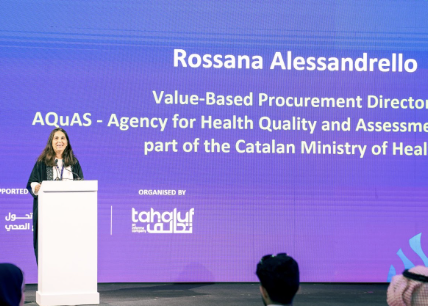
Agència de Qualitat i Avaluació Sanitàries de Catalunya (AQuAS)