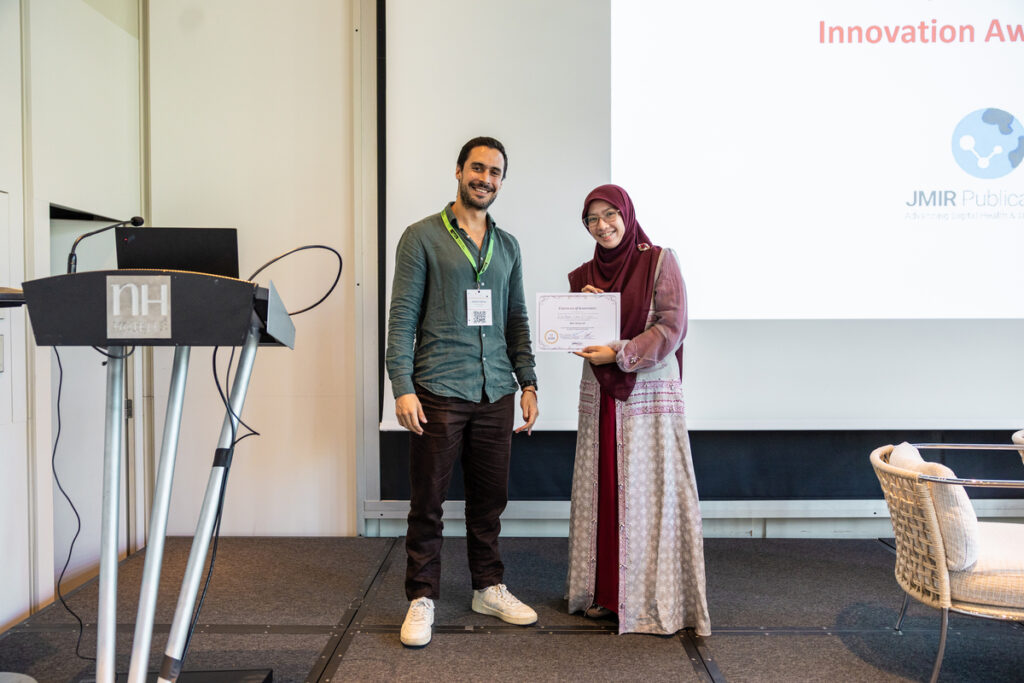
This project won the DPH 2026 Innovation Award – Best Scale-Up.
Team: Dewi Nur Aisyah, Suryastri Boni & Isaac Sjahrir Djauhari Jenie
Outline: Population-scale preventive digital health systems remain limited globally. In many settings, screening initiatives are implemented as time-bound campaigns or standalone applications that are not fully integrated into national health data infrastructure. This often results in fragmented reporting, inconsistent eligibility mechanisms, and limited interoperability across regions.
In February 2025, Indonesia launched Cek Kesehatan Gratis (CKG – Free Health Screening Program) as a nationally mandated life-course preventive screening programme embedded within SATUSEHAT, the country’s interoperable digital health ecosystem. Rather than developing a separate digital tool, CKG was designed to operate within existing national infrastructure to ensure standardised documentation, interoperability, and coordinated oversight from the outset.
Citizens access CKG through digitally integrated entry points including SATUSEHAT Mobile (Indonesia’s national citizen health application), assisted registration at primary healthcare facilities, and verified messaging channels such as Ministry of Health’s WhatsApp. Screening and clinical documentation are captured through SATUSEHAT IndonesiaKu (SSI), the national web-based platform used by primary healthcare facilities. Preventive records are stored within the unified SATUSEHAT architecture, enabling longitudinal tracking across facilities and real-time aggregated monitoring at district, provincial, and national levels. Screening results are made accessible to citizens through SATUSEHAT Mobile and secure messaging channels, allowing individuals to review their preventive health records and recommended follow-up actions beyond the initial encounter.
Within its first year of implementation, CKG enrolled over 70 million citizens, achieved daily enrolment peaks of up to 625,000 individuals, and activated 10,225 (99%) of primary healthcare centres (puskesmas) for structured digital reporting. Expansion to private clinics is underway in 2026, further strengthening integration across the mixed public–private delivery system.
The scale-up was enabled by three core digital design features: (1) Platform integration. Embedding CKG within SATUSEHAT ensured immediate interoperability with national data standards and eliminated parallel reporting systems, reducing duplication and fragmentation; (2) Registry-anchored targeting. Eligibility and identity verification are linked to authoritative civil registries, supporting consistent population identification across age cohorts and geographic regions; (3) Governance-by-design. Role-based access controls differentiate individual-level documentation for service providers from aggregated dashboards used for oversight, enabling continuous system-mediated monitoring while upholding data protection principles.
Prior to CKG, preventive screening coverage varied across regions, and data consolidation relied on manual reporting processes. Integration within SATUSEHAT enabled unified digital workflows, real-time reporting, citizen access to preventive records, and coordinated national oversight.
CKG demonstrates that large-scale preventive digital health can be achieved when prevention is embedded within national digital public infrastructure rather than implemented as a standalone application. By leveraging interoperable architecture, registry-based targeting, and governance-by-design, Indonesia operationalised preventive services at population scale while maintaining accountability and system integrity. The model offers a transferable framework for countries seeking to institutionalise prevention through interoperable and scalable digital systems.