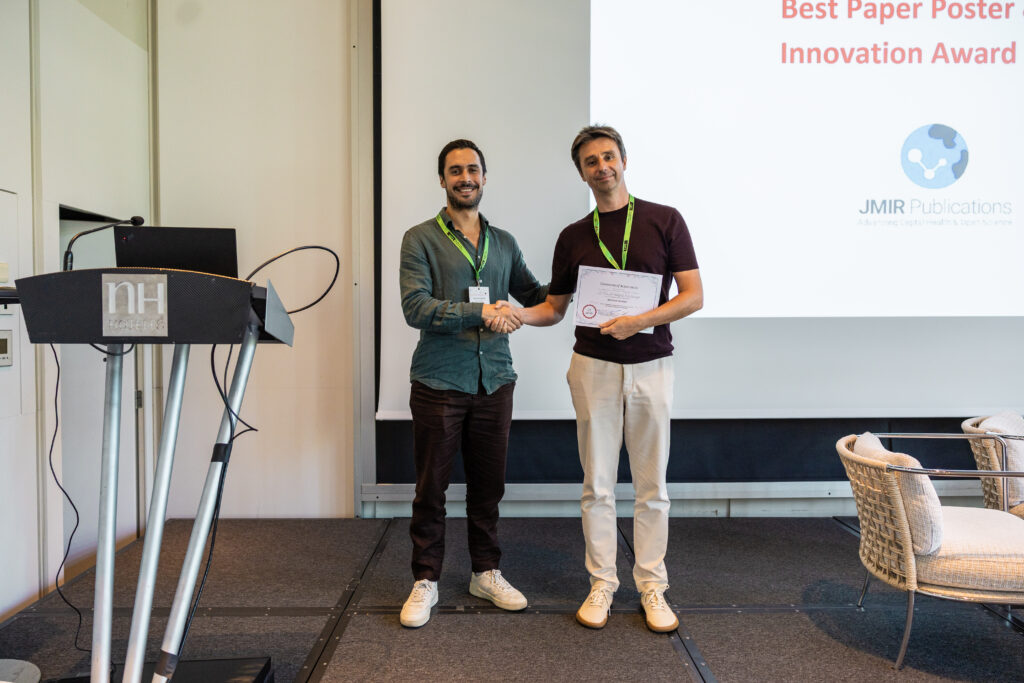
This project won the DPH 2026 Innovation Award – Best Partnership.
Team: Oleksandr Khil, Anel Kassymova & Dinara Alimbayeva
Outline: Allergic diseases affect more than 30% of the global population, yet access to structured allergy diagnostics remains limited in many regions. Patients often face delayed diagnosis, unnecessary restrictions, empirical treatments, or unstructured laboratory testing. While digital health tools are increasingly used for symptom tracking, few are integrated into real diagnostic pathways involving laboratory medicine and specialist care.
Allergy, like mental health, is a clinical field where diagnosis relies heavily on structured patient history. This makes it particularly well suited to conversational digital tools that can guide patients through symptom reporting in a systematic and clinically meaningful way.
AllergoChat addresses this gap by combining AI-supported patient dialogue with a structured diagnostic ecosystem developed through international partnership.
AllergoChat is a conversational digital system that helps patients organise allergy-related symptoms before consulting a physician. Through a structured clinical dialogue, the system identifies likely allergen groups and suggests appropriate tests and specialist referral. Its purpose is not to diagnose disease, but to support earlier, more precise diagnostic pathways and better-prepared medical visits.
What distinguishes this innovation is its multisector partnership model, connecting digital health development, laboratory diagnostics, and specialist clinical care across countries.
The platform was developed by Estrategia Unica, SL, a biomedical AI company based in Barcelona, and implemented in partnership with Olymp, one of the largest laboratory networks in Kazakhstan, and Divera Allergy Clinics, a network of specialised allergy centres.
Kazakh allergologists played a key role in adapting the system to local conditions, incorporating regional pollen calendars, dietary habits, and allergen exposure patterns. The Olymp laboratory network aligned AllergoChat recommendations with its diagnostic test menu, ensuring that suggested investigations correspond to validated assays available in clinical practice.
During implementation, the partnership introduced a structured reflex testing strategy within the Olymp laboratory network, linking digital symptom triage with stepwise laboratory diagnostics. AllergoChat recommends initial screening tests based on patient responses. When results indicate possible allergic sensitisation, predefined reflex testing algorithms automatically trigger additional targeted assays.
AllergoChat is designed to integrate reflex testing results into its clinical decision logic, creating a continuous interaction between digital symptom triage and laboratory diagnostics.
This integrated approach reduces the risk that allergic patients are lost in fragmented diagnostic pathways and shortens time to clinically meaningful diagnosis. It also promotes targeted testing instead of indiscriminate broad allergy panels, supporting more efficient use of laboratory resources.
Divera Allergy Clinics provide the clinical referral pathway for patients who require specialist evaluation. Physicians involved in the project supervise ongoing refinement of the clinical algorithms to ensure alignment with evidence-based allergy diagnostics.
All patient interactions are fully anonymised, allowing the platform to support public health education while maintaining strict privacy protection.
The AllergoChat partnership demonstrates how collaboration between technology developers, laboratory infrastructure, and clinical specialists can create a scalable model for improving allergy diagnostics and access to specialist care. It is available at allergochat.com.