
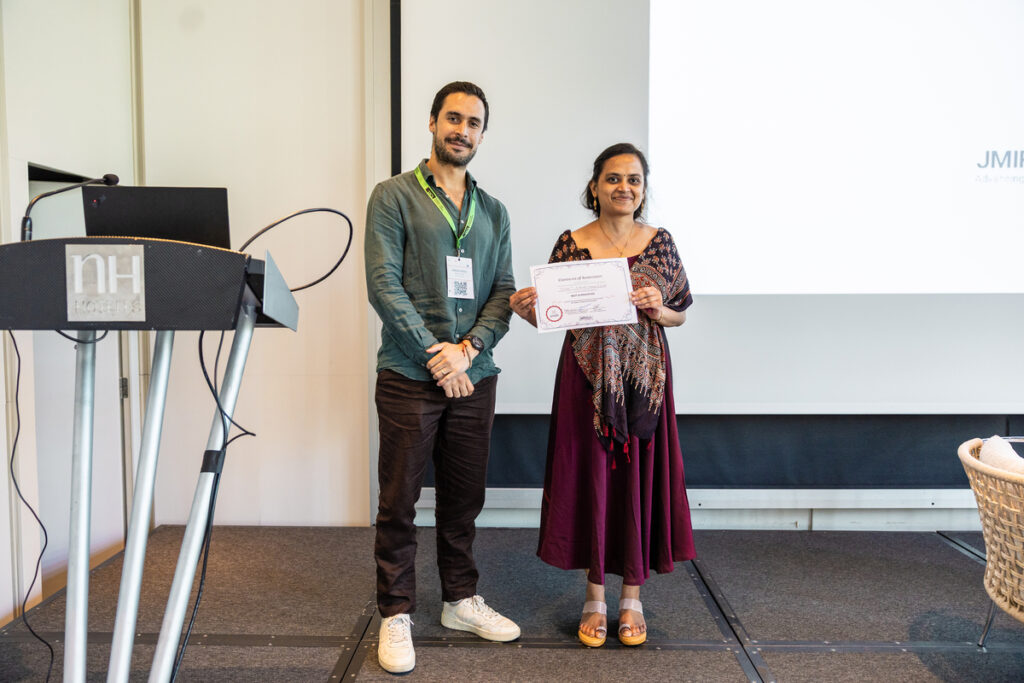
This project won the DPH 2026 Innovation Award – Best AI Innovation.
Team: Vinitha T, Prof Ashok Harnal, Dr.B G Prakash Kumar & Sunidhi Goel
Outline: AI-Enabled Knowledge Systems for India (AKSI) is a paradigm-shifting digital public health solution that transforms breast cancer early detection from an urban privilege into a nationwide reality. With 200,000 Indian women diagnosed annually yet 60% presenting at advanced stages when survival plummets, AKSI bridges the fatal gap between awareness and action through an integrated three-mode framework combining youth-powered digital campaigns, indigenous AI diagnostics, and systematic capacity building.
AI-Enabled Knowledge Systems for India (AKSI)focuses on being Youth-Centered Digital Transformation: Unlike traditional top-down health interventions, AKSI is based on evidence and is an effort to mobilize 2,000 student health ambassadors as trusted peer educators, leveraging Whats App group modules, Instagram interactive stories, and gamified learning to reach 100,000 youth where they already are—on their phones and in their social networks. Our baseline survey of 117 respondents revealed only 45% can identify symptoms beyond lumps, 54.7% don’t know proper breast self-examination technique, and 52.8% don’t practice monthly screening despite awareness. AKSI transforms passive knowledge into active practice through culturally relevant multilingual content across 12 regional languages.
AKSI utilizes Indigenous AI Diagnostic Ecosystem: AKSI deploys affordable, accessible technologies including Thermalytix thermal imaging (₹800 vs ₹3,000 mammography with approx. 73% cost reduction), AI-enabled Point-of-Care Ultrasound achieving 95-98% accuracy with uncertainty quantification, and edge computing deployment reducing power consumption 63% for rural settings with unreliable electricity. This isn’t imported technology adapted for India, but integrated Indian innovation designed for Indian realities, featuring offline-first capability, SMS fall backs, and mobile app flexibility.
AKSI ensures Seamless Government Integration rather than creating parallel systems, strengthens existing infrastructure through bidirectional data flow with the National NCD App, NPCDCS referral pathways, Ayushman Bharat Digital Mission health ID integration, and MeghRaj Cloud hosting ensuring data sovereignty and DPDP Act 2023 compliance. N8N workflow automation orchestrates multi-platform communications, appointment reminders, and referral coordination while JotForm handles patient-facing interactions, creating friction-free user experience. AKSI embarks to create not only Clinical Impact: AKSI detects 8 cancers per 1,000 screens (33% improvement over traditional methods) at ₹1.67 lakh per cancer detected versus ₹5 lakh traditionally which is 67% cost savings enabling broader coverage. Early detection shifts diagnosis from stages III-IV to stages I-II, catapulting survival rates from uncertain outcomes to 98%.
Economic Impact: Approx. Five-year projections show ₹50-100 crores savings through prevented Years of Potential Productive Life Lost, 40-50% treatment cost reduction through stage-shift, and 60-70% screening cost reduction enabling expansion to under served rural populations bearing highest burden with lowest access.
Social Impact: AKSI empowers women as active participants in their health rather than passive patients, normalizes breast health conversations breaking cultural stigma, and creates sustainable peer education networks outliving initial campaign timelines. Our four-level training cascade which includes from students to teachers to ASHA workers or healthcare professionals thereby addressing SDG 3 & 4 and creating permanent infrastructure for ongoing awareness.
AKSI utilizes human-centric design, data sovereignty, and is an inclusive rural-first development, inclusive of ethical deployment, AKSI provides a replicate model for Low middle-income nations especially the BRICS nations across inclusive of Iran, Brazil, and South Africa etc and globally through the Open-source N8N workflows enabled adaptation positioning India as not just implementing yet defined global best practices.
AKSI proves that combining accessible technology, comprehensive training, and youth mobilization transforms aspirational health outcomes into operational reality. From awareness to action, knowledge to practice, pilot to scale through AKSI makes early detection that saves lives not a privilege but a right, demonstrating how indigenous innovation can solve India’s most pressing public health challenges while establishing blueprints for global South-South cooperation.