
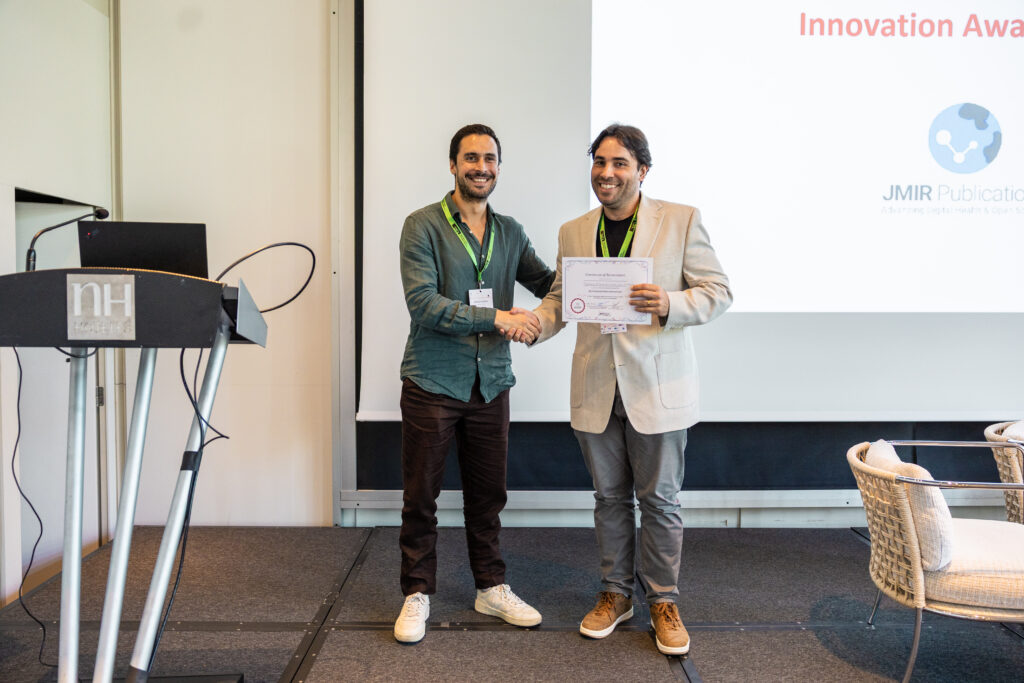
This project won the DPH 2026 Innovation Award – Best Engineering Innovation.
Team: Fernando Malheiros, Raquel Descie, Raiany Carvalho, Jeronimo Faria and Vinicius Vazquez
Outline
Background:
Melanoma is a highly lethal skin cancer when diagnosed at advanced stages, yet population-wide screening remains financially unsustainable for most public health systems. Surveillance of high-risk individuals is a more efficient strategy, but current Total Body Mapping (TBM) technologies rely on expensive proprietary equipment, limiting access in low- and middle-income countries.
Innovation & Engineering Approach:
We developed a low-cost engineering solution for digital Total Body Mapping based on high-resolution smart sensing and computer vision. The system uses conventional digital cameras (>25 megapixels) combined with a standardized acquisition protocol and a custom-built image processing algorithm capable of segmenting the body surface, registering multiple images, and generating a composite skin map with precise lesion localization. This Minimum Viable Product (MVP) reproduces key functions of high-end TBM systems at a fraction of the cost, enabling use in public health environments.
Digital Public Health Integration:
The platform is integrated with a digital risk-stratification tool (SAMScore) to support longitudinal monitoring of high-risk individuals. Images can be remotely evaluated through teledermatology, allowing decentralized screening while maintaining specialist supervision. This model connects engineering innovation, digital health, and public health surveillance in a scalable workflow suitable for large health systems.
Impact on Productivity & Efficiency:
Implementation simulations show a major improvement in clinical workflow efficiency. Examination time per patient decreased from approximately 3 hours to 30 minutes, allowing the number of monitored patients per shift to double without additional budget. Early detection of melanoma at surgically treatable stages reduces the need for costly immunotherapy and complex procedures, improving system sustainability.
Conclusion:
This project demonstrates how accessible sensing technology and custom computer vision algorithms can replace high-cost proprietary devices and enable scalable melanoma surveillance programs. The proposed solution provides a feasible model for strengthening secondary prevention within the Brazilian Public Health System (SUS) and other resource-limited settings, supporting the expansion of digital public health strategies worldwide.